
At the end of his book, The Second World War, John Keegan offers a list of 50 books in English that “together provide a comprehensive picture of the most important events and themes of the war, which are readable and from which the general reader can derive his own picture of the war as a guide to deeper reading.” ((John Keegan, The Second World War (New York: Viking, 1990), 596.)) Keegan admits this list is not all inclusive and it reflects his interests. For example, there is no book on the invasion of Poland in 1939.
The list is nearly 20 years old, but it is still valuable to those researching World War II. Some of these books are out-of-print, but most of them are readily available and have been republished several times which means Keegan put together a quality list.
1.) The West Point Atlas of American Wars, Vol 2 by Colonel Vincent J. Esposito is the first book listed. The books has since been broken up, expanded, and re-branded as The Second World War: Europe and the Mediterrean Atlas and The Second World War Asia and the Pacific Atlas. The books have detailed maps of all campaigns, not just the ones involving Americans. Even better, the new version are spiral-bound, which stands up better against wear and tear.
Hitler and Nazi Germany
 2.) Keegan recognizes Hitler A Study In Tyranny by Alan Bullock as the “best biography of Hitler,” and he was likely referring to the unabridged edition. ((Keegan 1990, 596.))
3.) Hitler’s War and the War Path by David Irving is an interesting recommendation by Keegan. The book has been criticized for years as being “pro-Hitler”, yet Keegan recognizes it as one of the most import books on the time period. ((Keegan 1990, 596.)) In a later book, Keegan acknowledges the criticisms of the book, but he also says it “is unique in that it recounts the war exclusively from the German side.” ((John Keegan, The Battle for History: Re-Fighting World War II (New York: University of Chicago Press, 1996), 50.)) Irving’s portrayal of Hitler is that of a man trying to do the best for his country. Keegan sees value in the book because of Irving’s work “in all the major German archives,” interviews with many survivors, and personal discovery of important documents. The major flaw Keegan sees in the book is “it is untouched by moral judgment.” ((Keegan 1996, 52.))
4.) The German Army and the Nazi Party, 1933-1939 by Robert O’Neill
5.) Inside Hitler’s Headquarters, 1939-45 by Walter Warlimont, one of Hitler’s operation officers.
6.) Inside the Third Reich by Albert Speer, Hitler’s armaments minister from 1942.
7.) Hitler’s War Directives 1939-1945 by Hugh Trevor-Roper lists approximately 80 major war directives given by Hitler starting with the invasion plans for Poland in 1939 to the last stand of the Reich in 1945.
8.) The Last Days of Hitler by Hugh Trevor-Roper
Beginnings and Early Battles
 9.) Keegan says that although The Origins of The Second World War by A. J. P. Taylor is contentious, it “cannot be bettered as an introduction to that subject.” ((Keegan 1990, 596.)) In a later book, Keegan described Taylor as a “notorious controversialist.” ((Keegan 1996, 9.))
10.) To Lose a Battle: France 1940 by Alistair Horne is the final installment of Horne’s trilogy on the major conflicts between France and Germany between 1870 and 1940 (The Fall of Paris: The Siege and the Commune, 1870-71 and The Price of Glory: Verdun 1916).
11.) Why France Fell: The defeat of the French Army in 1940 by Guy Chapman
12.) Parades and Politics at Vichy by Robert Paxton focuses on the French Army in 1940.
13.) The Breaking Wave: The Second World War in the Summer of 1940 by Telford Taylor focuses on the war between Britain and Germany during 1940 with particular attention to Hitler’s strategy.
14.) Hitler’s Strategy 1940-1941: The Balkan Clue by Martin van Creveld
15.) The Struggle for Crete by I. M. G. Stewart, a medical officer of one of the British battalions in the battle.
16.) The Desert Generals by Correlli Barnett details the battles throughout North Africa, focusing the German and Allied generals.
The War in the East
 17.) Keegan describes The Soviet High Command and the following two books by John Erickson as “overthrowing all other writers in English on the war in the east.” ((Keegan 1990, 597.))
18.) The Road to Stalingrad by John Erickson
19.) The Road to Berlin by John Erickson
20.) German Rule in Russia by Alexander Dallin
21.) Comrades in Arms: British Aid to Russia 1941-1945 by Joan Beaumont provides details on not only the policies implemented in Russia by the Germans, but also the policies considered and rejected.
Britain’s Strategy On Its Own
22.) The Continental Commitment by Michael Howard
23.) The Mediterranean Strategy in the Second World War by Michael Howard
Anglo-American Strategy
24.) Strategic Planning for Coalition Warfare, 1941-1942 by Maurice Matloff
25.) Strategic Planning for Coalition Warfare, 1943-1944 by Maurice Matloff
26.) Command Decisions by Kent Roberts Greenfield focuses on key decisions that had long-term repercussions during the war. Written for leaders, the book analyzes the information available to the commanders leading up to and during the decisions.
Code Cracking and Intelligence
 27.) British Intelligence in the Second World War by F. H. Hinsley focuses not only in how British intelligence operated throughout the war, but the influence it had on strategies and planning.
28.) The Hut Six Story by Gordon Welchman focuses on a British mathematician who was instrumental in breaking the German’s coded messages.
29.) Ultra Goes to War by Ronald Lewin focuses on how the Allies intercepted and decoding German transmissions during the war.
30.) The American Magic: Codes, Ciphers and the Defeat of Japan by Ronald Lewin focuses on the use of encoding, decoding, and decoys between America and Japan.
31.) Very Special Intelligence: The Story of the Admiralty’s Operational Intelligence Centre 1939-1945 by Patrick Beesly focuses on how the British utilized Enigma decoding to combat the German’s U-boat threat.
32.) Ultra in the West: The Normandy Campaign of 1944-45 by Ralph Bennett, a retired British intelligence major, details how the Allies used Ultra in campaigns throughout France and Germany. Bennett’s own experience as hands-on, as he was responsible for translating and annotating the decoded messages from the German Army and Air Force.
The War in the Pacific
33.) A History of Modern Japan by Richard Storry
34.) Empires in the Balance: Japanese and Allied Pacific Strategies to April 1942 by H. P. Willmott
35.) Eagle Against the Sun: The American War With Japan by Ronald Spector
36.) Coral Sea, Midway and Submarine Actions, May 1942-August 1942 by Samuel Eliot Morison
37.) Allies of a Kind: The United States, Britain and the War Against Japan, 1941-1945 by Christopher Thorne focuses on how Western colonialism and imperialism played a role in the war against Japan.
Wartime Economies and Efforts to Disrupt
 38.) War, Economy and Society, 1939-1945 by Alan Milward examines the economic relations between warring, allied, and neutral states through the world during the war.
39.) The Design and Development of Weapons by M. M. Postan, which is expensive and out-of-print but really cheap on the Kindle.
40.) Keegan values Bomber Command by Max Hastings “for its study of the effects of the campgain both on the Germans and crews who took part.” ((Keegan 1990, 598.))
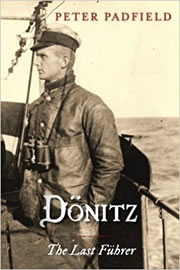
41.) Donitz: The Last Fuhrer by Peter Padfield provides a detailed look at the man who rose to Grand Admiral and led the U-boat campaign against the Allies throughout World War II.
The North-West Europe Campgain
42.) Keegan credits The Struggle for Europe by Chester Wilmot for effectively inventing “the modern method of writing contemporary military history, which combines political, economic and strategic analysis with eye-witness accounts of combat.” ((Keegan 1990, 598.)) While Keegan admits that some of Wilmot’s judgements are no longer valid, he believes the book remains “the supreme achievement of Second World War historiography.” ((Keegan 1990, 598.))
Resistence and Life Under Nazi Rule
43.) The Shadow War: European Resistance, 1939-1945 by Henri Michel
44.) The Embattled Mountain by F. W. Deakin, a memoir of a British paratrooper who found himself in the middle the Yugoslav partisan movement against Nazi occupation.
45.) Life with the Enemy: Collaboration and Resistance in Hitler’s Europe, 1939-1945 by Werner Rings focuses on Switzerland’s involvement in the war.
46.) The Final Solution: The Attempt to Exterminate the Jews of Europe, 1939-1945 by Gerald Reitlinger focuses on the early stages of persecution against the Jews, tracing sentiments, legislation, and events through the end of the war.
Personal Memoirs
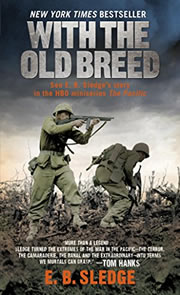 47.) Keegan is “haunted” by With the Old Breed: At Peleliu and Okinawa by E. B. Sledge, which he labels one of the “most arresting documents in war literature.” ((Keegan 1990, 598.)) Sledge writes of his experience growing up, going to war, and attempting to remain civilized while everyone around him became savages.
48.) Wartime by Milovan Djilas, an officer in Tito’s Yugoslavia, providing a firsthand account of the partisan campaign.
49.) Berlin Diaries, 1940-1945 by Marie Vassiltchikov, a 20-something Russian princess who worked in the German Foreign office and then as a nurse during the war, focusing on the lead up and then the effects of the failed 1944 assassination attempt against Hitler.
50.) The Past is Myself by Christabel Bielenberg, the memoir of a British author who married a German and lived in Berlin before and during the war.
You might also be interested in 8 books for the Military History Undergrad.